
A sports injury assessment starts by deciding whether you have a limb-threatening problem, a fracture or dislocation, or a soft-tissue injury that can be examined safely in clinic. You will know which details to record, what the examination involves, when imaging adds value, and which findings should change your next step.
Key takeaways
- Report the injury mechanism, exact timing, pain location, and any pop or deformity.
- Seek emergency care for loss of consciousness, severe deformity, or a cold, numb limb.
- X-rays show fractures; ultrasound checks soft tissue; MRI assesses ligaments, cartilage, and muscles.
- Return to sport only after pain-free movement, strength testing, and sport-specific assessment.
What should you report, and when is the injury an emergency?
A sports injury specialist in Pune after injury first decides whether you need emergency care, not whether you can start exercises. Report exactly when it happened, whether a twist, collision or fall caused it, where the pain began, and whether you heard a pop.
1. Describe what changed afterward: swelling, bruising, deformity, locking, giving way, worsening pain, reduced movement, numbness, weakness, or inability to bear weight. Tell the clinician about previous injuries and any blood-thinning medicine.
2. Seek emergency evaluation for an open wound over a suspected fracture, an obviously deformed joint, severe pain out of proportion to the visible injury, or a limb that is cold, pale, blue, numb, weak, or missing a detectable pulse. These signs can indicate fracture, dislocation, blood-vessel injury, or acute compartment syndrome.
3. After a blow, fall, or sudden acceleration and stop, report loss of consciousness even if it lasted seconds. Worsening headache, repeated vomiting, seizure, increasing confusion, unusual drowsiness, slurred speech, weakness, or unequal pupils requires emergency assessment rather than a routine appointment.
Do not force a suspected shoulder dislocation back into place; fracture or nerve damage can worsen. A clinician checks circulation and sensation, including feeling over the outer shoulder, before and after reduction. If no emergency sign exists, arrange prompt examination and avoid sport until assessed.
What does the physical examination check for each type of injury?
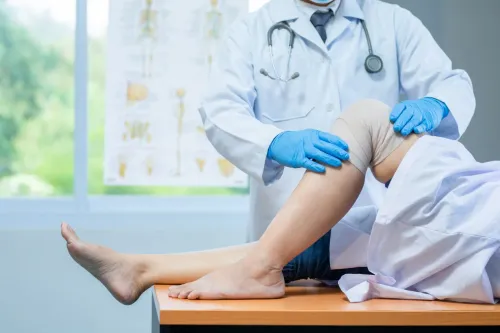
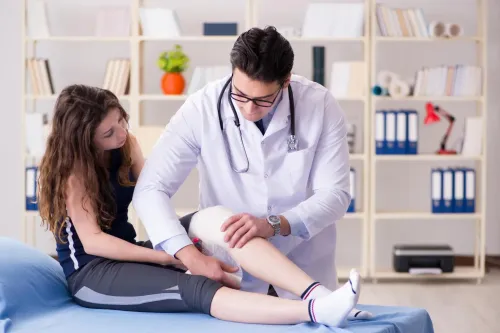
The examination checks alignment, swelling, bruising, tenderness, movement, strength, sensation, stability, gait and distal pulses. The clinician compares both sides and examines the joint above and below the painful area. They also ask whether a twist, planted foot, collision, fall or pop caused the injury, how quickly swelling appeared, and whether you could continue playing.
In an orthopedic sports injury in Pune, the examination changes with the suspected problem:
| Injury | What the clinician examines | What the findings may indicate |
|---|---|---|
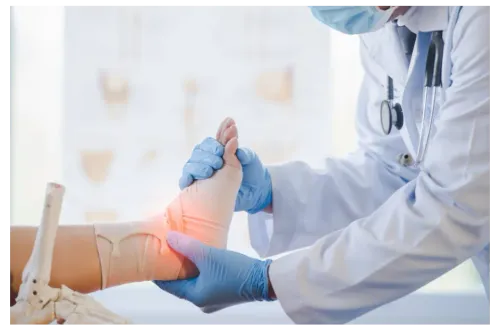
| Ankle sprain | Ankle and foot alignment, swelling, bruising, weight-bearing, range of motion, ligament tenderness, stability, sensation and pulses | Ligament damage, fracture, dislocation or nerve and circulation problems |
| Knee injury | Gait, joint-line tenderness, locking, range of motion, effusion, quadriceps strength and ligament tests; hip and ankle are also checked | Meniscus tear, ACL or collateral-ligament injury, patellar dislocation or fracture |
| Shoulder injury | Shoulder contour, active and passive movement, rotator-cuff strength, instability, sensation over the outer shoulder and arm pulses | Dislocation, rotator-cuff injury, fracture or axillary-nerve involvement |
| Suspected fracture | Deformity, focal bone tenderness, movement, skin wounds, sensation, motor function and pulses above and below the injury | Displaced fracture, open fracture or threatened blood supply |
| Muscle injury | Exact muscle tenderness, bruising, stretch pain, contraction strength and nearby joint movement | Strain, partial tear or complete rupture |
A cold limb, absent pulse, new numbness or marked weakness changes the urgency. For a suspected shoulder dislocation, sensation and circulation are checked before and after reduction.
When do you need an X-ray, ultrasound or MRI?
A normal X-ray does not rule out a sports injury. It can miss a torn ligament, meniscus or tendon, cartilage damage, muscle injury and an early or occult stress fracture. The specialist chooses imaging after matching the injury mechanism with tenderness, swelling, movement, strength, stability and ability to bear weight.
| Test | What it shows best | When it applies |
|---|---|---|
| X-ray | Fracture, dislocation, bone alignment | First for suspected fracture after a fall, collision or twisting injury |
| Ultrasound | Tendons, muscles, fluid and movement in real time | Suspected Achilles or other tendon injury when examination findings are unclear |
| MRI | Ligaments, menisci, cartilage, muscles and hidden bone injury | Persistent symptoms, suspected internal knee damage or an occult fracture after initial assessment |
For a painful knee, MRI is not automatically the first test. Plain radiographs usually come first when acute trauma suggests a fracture; MRI follows when examination points to meniscal, ligament, cartilage or occult-bone injury, or when symptoms continue despite appropriate care.
For suspected Achilles rupture, the clinician may use the Thompson test and heel-raise assessment before ordering ultrasound or MRI.
An orthopedic sports injury in Pune should offer timely imaging access without letting a scan replace examination. A suspected fracture or dislocation needs immobilisation and urgent care; uncomplicated soft-tissue injuries need a loading and rehabilitation plan matched to the tissue involved.
How are concussion, treatment and return to sport assessed?
A head impact is assessed as a possible concussion even without loss of consciousness. The clinician asks about the blow, fall or rapid acceleration, then checks headache, dizziness, nausea, light or noise sensitivity, memory, concentration, eye movements, balance, coordination and neck symptoms.
Worsening headache, repeated vomiting, seizure, increasing confusion, unusual drowsiness, slurred speech, weakness, unequal pupils or loss of consciousness require emergency evaluation.
Treatment follows the findings, not a standard “rest and ice” formula. A suspected fracture or dislocation may need immobilisation and urgent radiographs; an uncomplicated soft-tissue injury usually needs protected activity, controlled loading, movement and rehabilitation. Complete rest for too long can weaken the injured area, while indefinite painkiller use can mask deterioration.
Concussion recovery does not end when symptoms disappear later that day. A healthcare professional supervises this six-step return-to-play progression, keeping you at least 24 hours on each step:
- Regular daily activities that do not worsen symptoms
- Light aerobic exercise, such as walking or stationary cycling
- Moderate activity with increased movement
- Non-contact sport-specific drills
- Full-contact practice after medical clearance
- Competitive play
If symptoms return, stop, contact the clinician and return to the previous tolerated step. For other injuries, clearance requires restored range of motion, strength, balance and sport-specific movements without significant pain or instability—not merely a set number of days since injury.
How do you choose timely follow-up for sports injury care in Pune?
Choose a service that can manage the next decision, not just provide a first consultation. Compare imaging access, fracture or dislocation treatment, rehabilitation planning and the ease of seeing the same clinician again.
| Service feature | What to compare | Why it matters |
|---|---|---|
| Imaging | On-site X-ray, MRI referral, reporting time and access for repeat films | A normal X-ray can miss ligament, tendon, cartilage or stress injuries; suspected dislocation or fracture needs timely imaging and alignment checks |
| Acute injury care | Immobilisation, fracture management, neurovascular checks and safe dislocation reduction | Delayed care can worsen displacement, nerve injury or swelling; do not accept casual manipulation |
| Rehabilitation | Physiotherapy access, home exercises, progressive loading and sport-specific testing | Complete rest alone can cause stiffness and weakness, while early overload can prolong the injury |
| Follow-up | Planned review, access for worsening symptoms and written return-to-sport milestones | Recovery should track motion, strength, balance, sport movements, pain and instability—not calendar days |
Search terms such as sports injury specialist bibwewadi, sports injury doctor kondhwa and sports injury treatment hadapsar identify locations, not quality. Ask who reviews the scan, who handles a new deformity or increasing pain, and whether rehabilitation begins after diagnosis rather than after symptoms simply settle.
At Spire Hospital-Best Orthopedic Hospital in Pune, ask whether imaging, fracture or dislocation care, rehabilitation and scheduled review are coordinated for your injury. Choose the nearby service that can cover these steps without sending you to separate providers when your condition changes.
Related service
Orthopedic Treatments Best Sports Injury Treatment Specialist in Bibwewadi, Dhankawadi, Market Yard, Kondhwa, Pune Dr. Gaurav Pawar is one of the leading and best Best Sports Injury Treatment specialists at Spire Hospital in Bibwewadi, Pune. View service → |
Frequently asked questions
What should you report after a sports injury?
Tell the specialist when the injury happened, whether it involved a twist, collision, or fall, where pain began, whether you heard a pop, and whether swelling, numbness, weakness, or loss of movement followed.
When is a sports injury an emergency?
Seek emergency care for loss of consciousness, confusion, repeated vomiting, severe deformity, uncontrolled bleeding, inability to bear weight after major trauma, or a limb that is cold, pale, blue, numb, or pulseless.
What does a physical examination check after a sports injury?
The examination compares both sides for swelling, bruising, deformity, tenderness, range of motion, joint stability, muscle strength, sensation, circulation, and the movements that reproduce pain.
When do you need an X-ray, ultrasound, or MRI?
An X-ray checks bones and dislocation. Ultrasound assesses accessible tendons, muscles, fluid, and some ligament injuries. MRI gives detailed views of ligaments, cartilage, menisci, muscles, and bone marrow.
How is return to sport assessed after injury?
The clinician checks pain-free movement, swelling, strength, balance, coordination, sport-specific drills, and the ability to complete training demands without symptoms.
Keywords